How Leaders Create Solutions: The Factors of Production
LEADERSHIP TODAY, Episode 5
Over the past four weeks, we have been laying a foundation.
We started with scarcity: the fact that human needs are unlimited but the resources to meet them are not, and that this gap is one of the reasons leadership exists. We moved into opportunity cost: every choice a leader makes closes a door somewhere else, and ignoring that cost does not make it disappear. We sat with the discipline of diagnosis or situational analysis: learning to see a problem clearly before rushing to act, distinguishing symptoms from root causes, and resisting the pressure to move before we understand. And last episode, we turned to human behaviour: why rational individuals, each acting in their own interest, can produce outcomes that harm everyone, and why the systems we build shape the choices and actions of people.
So the question this week is practical: What do leaders and entrepreneurs actually use to create solutions?
The factors of production
Every solution ever built, anywhere in the world, required some combination of four inputs: land, labour, capital, and technology. No exceptions. Whether we are talking about a hospital in Tamale, a tech startup in Silicon Valey, a school feeding programme in Kigali, or an AI Data Center in Ohio, these four inputs make it possible.
Land is every natural resource at our disposal. Soil, water, minerals, physical space. Think about the young woman in the Northern Region who wants to start a shea butter business. Before she does anything else, she needs access to shea trees and a place to process the nuts. Every solution begins somewhere physical.
Labour is human effort. But not all labour is the same. Unskilled labour, for instance, is physical effort requiring minimal formal training, like the hands that harvest crops or load goods at a market. Skilled labour is specialised work that demands education, apprenticeship, or experience, like the software developer in Accra building a fintech app, or the nurse working at the rural clinic. Managerial labour is the capacity to organise, coordinate, and direct the work of others. And then there is entrepreneurial labour, which is the ability to see opportunity where others see a problem, take a calculated risk, and build something new. That is the person who looks at a broken system and says, "I can fix this” or sees a need a says, “I want to produce to meet it”.
Capital also comes in many forms. Financial capital is the money, credit, or investment we need to get started. Physical capital is the equipment, buildings, tools, and vehicles that make work possible. Human capital is our knowledge, skills, and health. And social capital is the relationships, trust, networks, and reputation we have built.
Think about it this way. Many of us know someone with a brilliant idea but no money to start. That is a lack of financial capital. We also know someone with money but no real relationships. That person will struggle too. A leader or entrepreneur who has money but no relationships will stall. One who relationships but no money will also stall. Effective leaders and entrepreneurs learn to build and combine multiple forms of capital.
Technology is the multiplier. A farmer with a hoe feeds a family. A farmer with irrigation and data feeds a community. A teacher with a blackboard reaches thirty students. A teacher with a digital platform reaches three thousand.
And today, social media and artificial intelligence is accelerating this further. AI can analyse customer data for a small business, help a student learn at their own pace, automate repetitive work, and help leaders and entrepreneurs build better and faster with fewer resources. We do not need to wait for some distant future to benefit from this. The tools are here now. Technology does not replace leadership. It expands what leaders and entrepreneurs can produce.
But not everyone starts with the same tools
Now, knowing the four factors of production is one thing. The harder truth is that none of us start with the same amount of them. What we begin with is called our factor endowment: the land, labour, capital, and technology already available to us before we do anything.
Ghana's factor endowment includes arable land, cocoa, gold, a young and energetic population, and growing digital connectivity. Rwanda's includes strong governance systems and a culture of discipline. Nigeria's includes a massive consumer market and entrepreneurial energy that is difficult to match anywhere on the continent. Each country has something. No country has everything.
And this is true at the personal level too. Maybe we do not have financial capital right now, but we have skills. Maybe we do not have a big network, but we have a rare talent. That is still an endowment. That is still something to build with.
So the question is "What do we do with what we have?" And this is where comparative advantage matters. It is not about being the best at everything. It is about focusing on what we can produce at the lowest opportunity cost relative to others. A person that tries to produce everything produces nothing well.
Wise leaders and entrepreneurs audit what they have, identify where their advantage lies, and concentrate their factors of production there. They trade for the rest. They partner for the rest. They do not wish scarcity away. They specialize to make the most of their factor endowment.
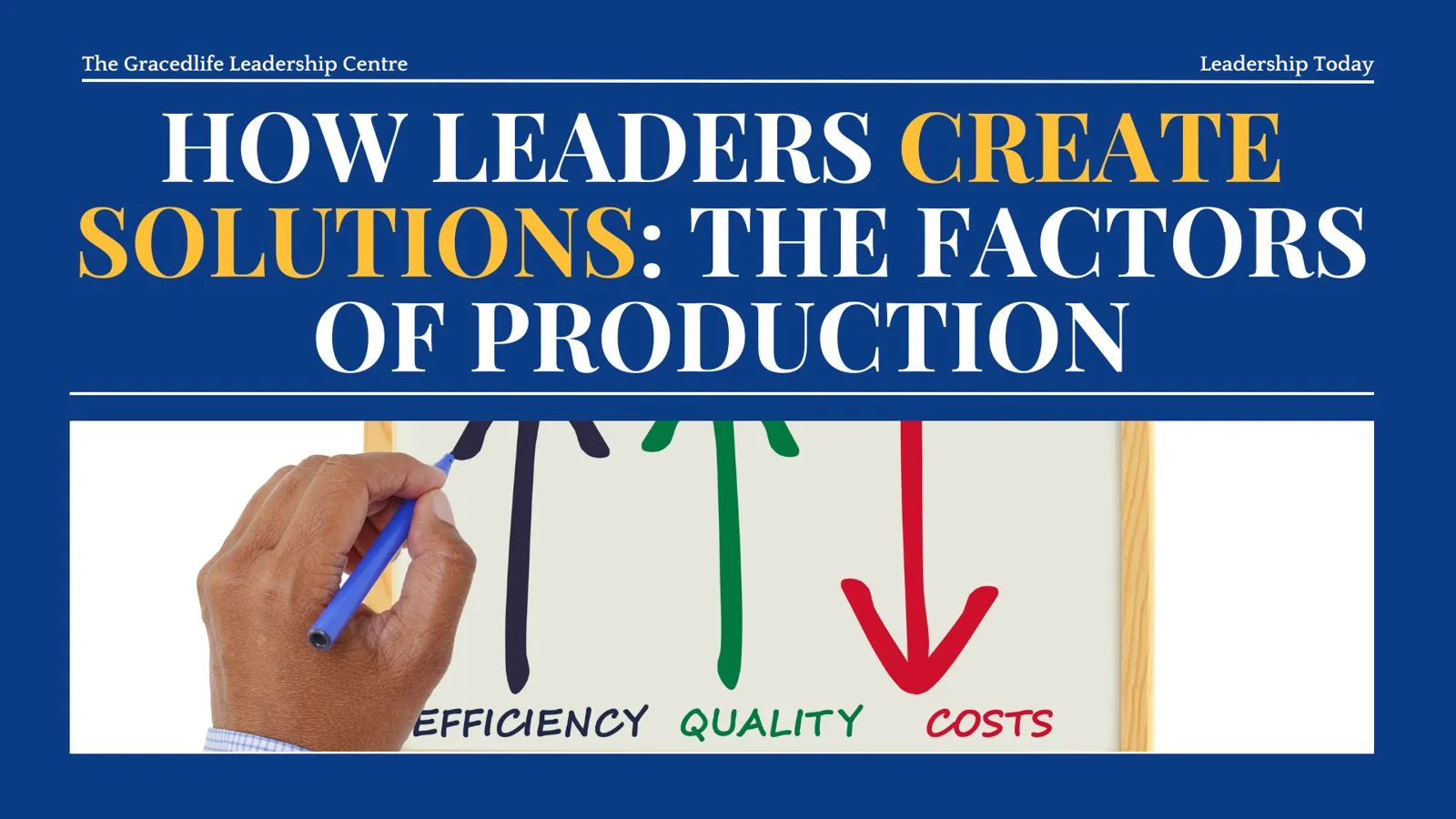
The goal: minimize cost, maximize productivity
Having factors of production is not enough. What separates effective leaders and entrepreneurs from everyone else is how efficiently they use them.
Every input has a cost. Land costs money or access. Labour costs wages, training, and time. Capital costs interest, maintenance, or years of relationship-building. Technology costs investment and learning. The goal is always to get the most output from the least input. That is productivity. And productivity is not greed. It is stewardship. Because when we waste resources, we are not just losing money. We are losing the opportunity to serve more people, solve more problems, and sustain the solution longer.
This is why technology matters so much. It is one of the most powerful ways to reduce cost and increase output at the same time. The business that automates saves hours every week. The farmer who uses weather data plants at the right time and loses fewer crops. AI takes this even further by helping us do in minutes what used to take days.
Minimizing cost and maximizing productivity is not just a business principle. It applies to every environment where leaders and entrepreneurs operate. The factors of production are always limited. That is the reality we started with in Episode 1. So the question is never just what we produce, but how efficiently we produce it.
Once we know what we can produce, the next question is: who should we produce for?
Because producing something doesn’t mean people will want it or buy it or like it.
Every solution has a product, which is what is actually being offered, and a benefit, which is the value it delivers to the person receiving it. A clinic is a product. Better health for a family is the benefit. A coding bootcamp is a product. A young person who can now earn a living through technology is the benefit.
Leaders and entrepreneurs who confuse the product for the benefit end up building things nobody wants or like. Understanding the benefit leads us to the question of demand, which is wants backed by purchasing power. And this distinction splits the kinds of solutions leaders and entrepreneurs can create into two categories. In the next episode, I will talk about this.
Until next week, lead today. Lead yourself and lead others. We are TGLC.