Why Solutions Fail and What Every Leader Must Do
A good doctor knows that what you feel may not be what is actually wrong. The headache could be dehydration. The fatigue could be stress. The stomach pain could be something you ate last week. So the doctor asks questions. Runs tests. Traces the history. Only after understanding what is truly happening does the doctor prescribe. This is called diagnosis. And it is where leadership must begin.
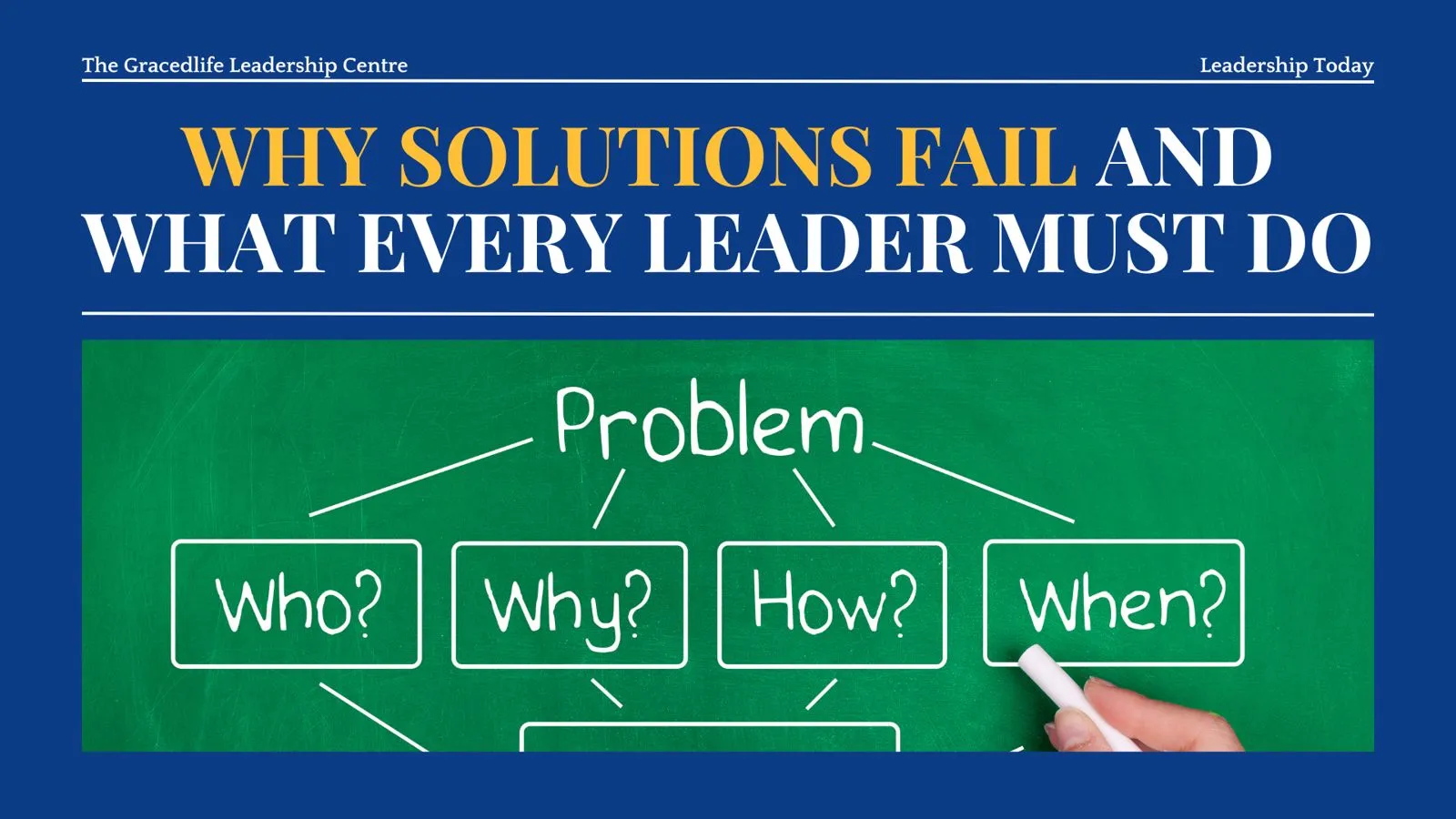
LEADERSHIP TODAY, Episode 2
Last week, we said leadership exists because life has limits. Resources are limited. Time is limited. Intelligence is limited. Because we cannot do everything at once, every yes becomes a no to something else. Someone must decide what gets done, what gets prioritised, and with what resources. That is leadership.
But knowing that we must choose does not tell us what to choose. And it does not tell us what will actually work.
This is where many leaders fail, not from lack of effort, but from acting before understanding.
Leadership begins with diagnosis
Think about what happens when we are sick. We go to the doctor. The doctor does not immediately say, "Okay, what is hurting?" and then hand us medicine. A good doctor knows that what we feel may not be what is actually wrong. The headache could be dehydration. The fatigue could be stress. The stomach pain could be something we ate last week.
So the doctor asks questions. Runs tests. Traces the history. Only after understanding what is truly happening does the doctor prescribe.
This is called diagnosis. And it is where leadership must begin.
Many young leaders, and many experienced ones, skip diagnosis. They see a problem, feel the urgency, and immediately think they can fix it. But treating what we can see without understanding what is causing it is one of the most expensive mistakes a leader can make. We waste time. We waste resources. We lose trust. And the problem returns, often worse than before.
Think of how many leaders in government, in organisations, in families have risked everything to fix a problem, only to watch it return within a few years, sometimes even stronger. Not because they lacked courage. Not because they lacked resources or people. But because they never truly understood what they were trying to fix.
The 5 Whys (and why it matters)
One useful framework is called the Five Whys. It is simple: just keep asking why until we reach the root. It does not end at five, we keep going until we arrive at something we can actually address.
Take youth unemployment in Africa, for instance:
- Why are so many young people unemployed? Because there are not enough jobs.
- Why are there not enough jobs? Because there are not many businesses to absorb the workforce or create the value needed to employ people.
- Why are there not many businesses? Because the environment makes it difficult, high costs, poor infrastructure, limited access to capital.
- Why is the environment so difficult? Because governments have not built the right infrastructure or systems that enable development.
- Why have these systems not been redesigned? Because the same systems and policies shaped the leaders who inherited them, and produced more of the same.
By the fifth why, we often arrive at something we can actually address. The point is not to sound clever. The point is to stop guessing.
Cause-and-effect is not always simple
Diagnosis does not stop at asking why. We also need to understand what kind of relationship exists between cause and effect, because correlation is not the same as causation. Two things can happen together, or one after another, without one causing the other.
Not all problems behave the same way. The relationship between cause and effect determines how we must respond:
- Direct causes: One input, one output. Simple to trace and fix.
- Delayed causes: The effect shows up years after the cause.
- Compound causes: Several small failures stack into one disaster, where fixing just one changes nothing.
- Misleading causes: The loudest symptom is not the real cause at all.
- Circular causes: The effect becomes the new cause, creating a loop that keeps reinforcing itself.
This last one is where things get difficult.
The reinforcing loop
When we at TGLC began researching Africa's current challenges, we wanted to understand the true cause, not just the visible symptoms. What we found was that the problems are not isolated. They are connected by reinforcing loops, where one problem feeds another, which feeds another, which feeds the first.
Consider this cycle:
- Poor ethical culture weakens institutions and slows economic growth.
- Weak institutions and slow growth lead to lack of job opportunities and unemployment.
- Unemployment deepens poverty.
- Poverty breeds a scarcity mindset.
- A scarcity mindset fuels social vices.
- Social vices enable corruption and bad governance.
- Corruption and bad governance gut the education system.
- A poor education system fails to instil ethical culture and develop good leaders.
- And the cycle begins again.
Round and round it goes. Each problem feeds the next. And the longer it runs, the harder it is to break.
Why single interventions fail
Consider what happens when we try the obvious fix.
We say, "Let us build a school, a really good school." Students receive good education. Then they go home to families where leadership is weak, where values and principles do not matter, where accountability is absent. They return to communities shaped by the same patterns, influenced by peers who attend not-so-good schools. They enter workplaces where the culture is poor and rewards silence over integrity.
So the person who shows up on time, who demands accountability, who refuses to cut corners, often becomes a target. Those who have been in the system for long push back. The system does not reward good behaviour, it punishes it. And over time, the person either conforms or leaves the country.
This is what a reinforcing loop does. One intervention, even a good one, gets absorbed and neutralised by a larger system. The school alone cannot fix the home. The home alone cannot fix the community. The community alone cannot fix the institutions. Everything is connected. Everything reinforces everything else.
Build balancing loops
If the problem is a reinforcing loop, the solution must be a balancing loop, an intervention that creates counter-pressure at multiple points simultaneously.
This is why TGLC's approach is not to build one institution, but to build a network of leaders. We call it the democratisation of leadership development.
Leaders of themselves first. Leaders in their homes. Leaders in their communities. Leaders across every sector, schools, markets, media, social enterprise, government. And these leaders are not scattered or left alone. They are connected, bound by one goal and the same value system.
Imagine, in a few years, over 1,000 leaders across Ghana as part of a single network. Among them: lawyers, politicians, pastors, business owners, teachers, parents. All trained in the same principles and values. All accountable to the same standard. All reinforcing each other.
That is the balancing loop we are creating, a counter-solution to the reinforcing loop we identified. And with this vision spreading throughout Africa, imagine what the impact could be.
How this applies to your own life
The same framework works at the personal level. Assume you are struggling financially. Ask: Why am I poor? And keep asking. Keep tracing. Until you reach the root cause. Then go back with first-principle thinking: What is actually true about me? About money? About my situation? About life? And begin to build from there.
That way, we tackle the problem from the root instead of treating symptoms that may not solve anything.
The leaders Africa needs
Leadership does not begin with action. It begins with understanding. Before we fix, we diagnose. Before we prescribe, we trace. Before we build, we ask what the system will do to what we build.
The leaders Africa needs are perhaps not the loudest. They are the ones who see clearly, think carefully, and build wisely.
Until next week: lead today. Lead yourself so you can lead others. We are TGLC.