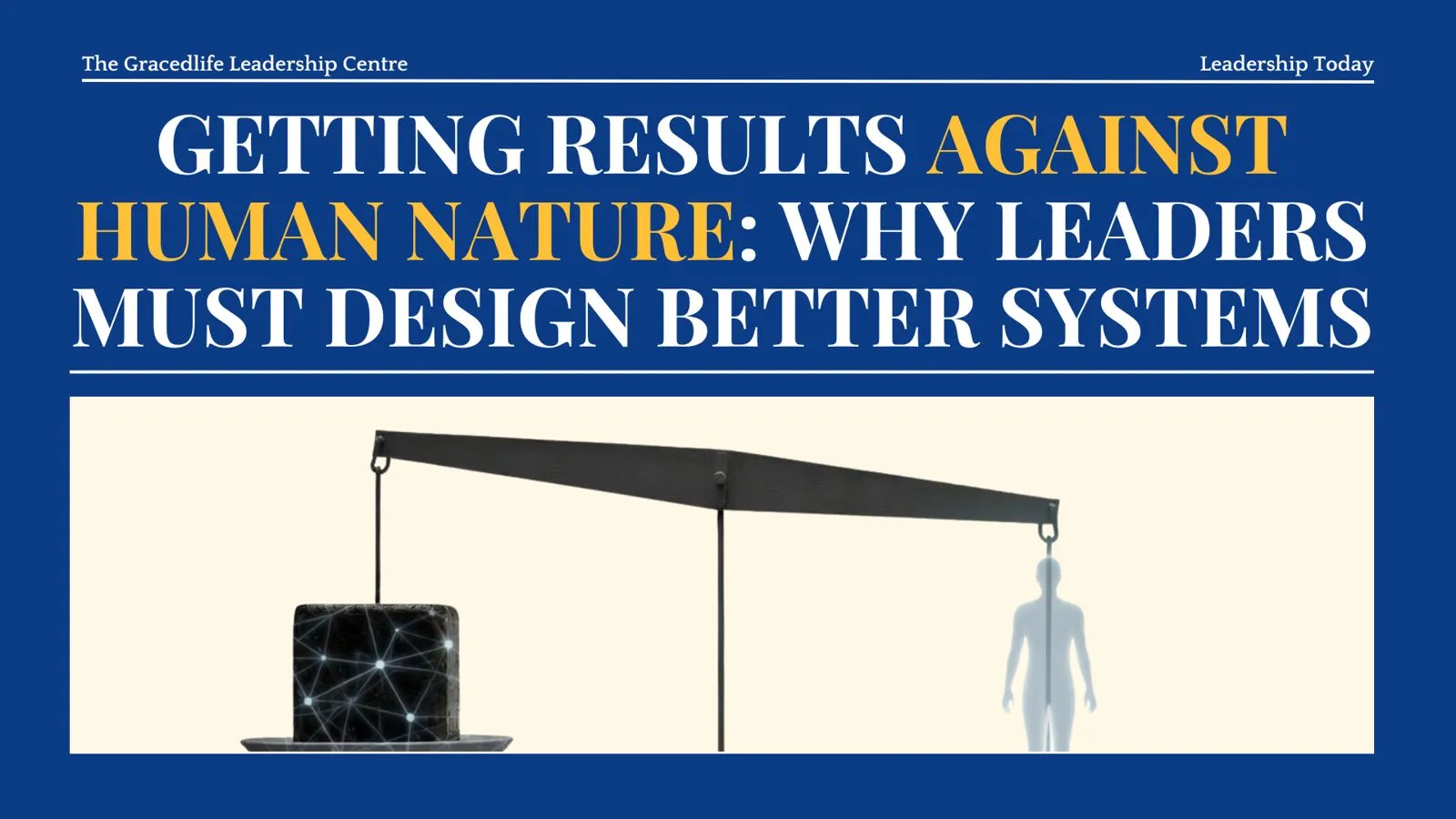
Getting Results Against Human Nature: Why Leaders Must Design Better Systems
LEADERSHIP TODAY, Episode 4
So far, we have established that life has limits: limited resources, limited time, limited energy. Even limited intelligence. Hence the need for leadership to prioritise factor endowment against constraints, minimise cost and waste, and maximise returns and benefits for all. We have said that before a leader acts, the leader must, at least, diagnose: trace cause and effect, and even the kind of relationship between the cause and effect, identify reinforcing loops, and understand why single interventions often fail inside complex systems. And we have argued that even after diagnosis, the leader must understand the environment the situation is occurring and the game being played, whether zero-sum, negative-sum, or positive-sum, because cooperation and oneness multiply capacity while zero-sum thinking destroys it.
Now we must execute. And execution means working through people. Proverbs 14:4 says, “Where there are no oxen, the manger is clean, but much revenue comes by the strength of the ox”. Meaning, we need people and the issues that come with them, else we can’t achieve much.
I have to add that not every leader arrives at their destination the same way. Some follow the sequence: diagnose, strategise, then act. Others just build. They start before they fully understand the problem, before they have the right people, before they have a good strategy. They figure things out as they go. It can be costly though. Wasted years, broken relationships and partnerships, resources spent on the wrong things. But through persistence and agility, some of them grow anyway.
What separates those who grow from those who fall apart? I think at some point, the ones who survive stop relying on instinct alone and start building effective systems. The ones who never make that shift eventually hit a ceiling they cannot push through. The organisation stalls, or the family fractures. The initiative collapses under its own weight.
Either way, the destination is the same: we must confront human nature as it actually is.
Last time, we explored the Prisoner's Dilemma. We used that to illustrate why cooperation is so rare and so fragile. But there is a deeper problem hidden inside the dilemma, one that the philosopher Derek Parfit spoke about in his book Reasons and Persons.
Parfit's argument is that the very principle of rational self-interest, "always do what is best for yourself," is directly collectively self-defeating. When each person follows it, the result is worse for everyone, including the person who followed it. So with the Prisoner's Dilemma, each prisoner reasons correctly from self-interest. Each makes the "rational" move to betray. And each ends up worse off than if they had both acted against their narrow self-interest.
Parfit calls these "Each-We Dilemmas." What is rational for each leads to outcomes that are terrible for all. The logic that says "I should maximise my own advantage" is not wrong in isolation. But when everyone follows it simultaneously, it destroys the very outcomes each person was trying to secure.
Parfit's deeper insight is about human nature itself. We are, by default, self-seeking creatures. Not because we are evil, but because self-interest is the most immediate, most instinctive driver of behaviour. We feel our own hunger before we notice someone else's hunger. We calculate our own risk before we consider the group's. We protect our own position before we think about the team.
And this shows up in our everyday life. We copy an assignment because the deadline is tonight. We let a colleague swipe our attendance card even though we never stepped foot at work that day. We stay quiet when the trotro mate forgets to collect the fare, because the money could go toward something else. We take the illegal route to get to work on time because everyone else is using it. We are not villains in our own story. Most of us would describe ourselves as good, reasonable people. And we would be right. Our actions are for a good reason. But that is precisely the problem. We are doing what is reasonable for ourselves, in the short term, inside an environment that makes self-interest easy and doing what is right for everyone costly.
We will cut corners. We will save face. We will seek our own glory. We will protect our own interests. We will take shortcuts when the long road is hard and no one is watching.
That is not cynicism. That is what Parfit demonstrated with philosophical precision and what every experienced leader knows from practice: self-interest, left unchecked, erodes the very outcomes everyone desires most for the community or country.
So the question is not, "How do we find trustworthy people?" or "How do we inspire people to be better?" Those are fine aspirations, but they are not strategies.
The real question is: How do we build systems that still produce good outcomes even when people behave exactly as we should expect them to behave: imperfectly, self-interestedly, and inconsistently?
This is one of the most important shifts a leader can make: from relying on character to designing environments.
In the early days of ATMs, the machines dispensed cash first and returned the card after. The logic seemed reasonable: people came for cash, so give them the cash.
But many people took the money and walked away, leaving their card in the machine. Banks lost cards. Customers were frustrated.
How did banks solve it? They did not launch a customer education campaign. They did not put up signs saying, "Please remember your card." They did not appeal to people's sense of responsibility.
They changed the order. Now the machine returns the card first. Only after the customer takes the card does the cash come out. The customer's own desire for cash ensures the card is retrieved.
Behaviour changed. Not because people changed, but because the system changed.
It would be convenient if people simply changed. If we could gather everyone in a classroom and educate them on what is right and wrong, and watch everyone align, wouldn't that be great? That sounds like a good idea. But a good idea is not always the ideal solution. Maybe some will change. Maybe.
But anyone who has led a team, raised a family, or tried to change a habit in themselves already knows the answer. Not reliably. Not consistently. And not at scale. So the principle is straightforward: when we design systems and environments that work with human nature instead of against it, we get better outcomes without waiting for people to become who we wish they were.
I have to point out also that most systems are designed around how we wish people would behave. We write policies and expect compliance. We set rules and expect obedience. We announce values and expect alignment. Then we are surprised when people cut corners, ignore procedures, or game the system.
But if we look honestly at how people actually behave, under pressure, under temptation, under stress, we begin to see that the system itself is often the teacher.
If compliance is difficult and wrongdoing is easy, the system is teaching people to fail. If the right path is obvious, convenient, and rewarded, the system is teaching people to succeed.
Consider two offices. In one, expense reports require five signatures, take three weeks, and no one checks them anyway. Employees learn quickly: either inflate the numbers or avoid the long process entirely. In the other, expenses are submitted digitally, approved within 48 hours, and randomly audited with real consequences. Employees learn a different lesson: honesty is efficient, and dishonesty is risky.
Same people. Different systems. Different outcomes.
This applies at every level. In families, routines shape what "normal" becomes. A family that eats together, prays together, and talks openly does not produce those habits by accident. Someone designed that rhythm. Over time, the routine becomes culture, and the culture shapes character. Children raised in that environment do not need to be told every day to show up. The system carries them.
In organisations, incentives shape what is rewarded. If promotions go to those who deliver results regardless of how they get results, the organisation is training leaders to be ruthless. If promotions go to those who build teams, mentor others, and deliver results with integrity, the organisation is incentivizing a different kind of actions. The incentive structure is the real curriculum, not the company values on the wall.
In nations, the families and the education system, together with law enforcement and accountability shape what becomes culture. When families teach integrity early, when schools reward honest effort over “who is first and who is last”, when laws are clear, courts are functional, and consequences are real, the people learn that the rules matter. When parents tell their children to say "Mummy is not home" when she is sitting right there, when schools reward memorisation over understanding and certificates over character, when laws are selectively enforced, when the powerful are exempt, and when corruption carries no cost, people learn a different lesson: the rules are for show - If you can beat it, beat it. Over time, that lesson becomes national culture. And culture, once set, is extremely difficult to change.
So what does this mean for us as leaders?
It means we are to see things as systems instead of isolated parts. When we see things as systems, we see the people who make up the system, we see the environment they live in influencing their actions, we see the incentives shaping their choices, and we see how all of these interact to produce the outcomes we either celebrate or complain about.
Our job is not simply to tell people what to do. That’s easy, but may not get the results we want consistently and at scale. Our job is to create effective systems (which includes the people, the environment, the incentives, the technology) that makes doing the right thing natural, easy, and rewarding.
So first, understand predictable human weakness. Do not design solutions for saints. Design solutions for stressed out, distracted, self-interested human beings, because that is who we all are on our worst days. A system that only works when everyone is at their best is a system waiting to fail.
Second, remove friction from the right actions. Make it easy to do what is right. If we want people to save money, automate the deduction before they see the paycheck. If we want students to study, make the learning materials accessible and the distractions costly. If we want employees to report problems, make the reporting process safe and simple.
Third, add friction to the wrong actions. Make it harder to do what is wrong. Not impossible, because people are people regardless of the system, but extremely hard - inconvenient enough that the default shifts. The ATM example works precisely because the machine made it harder to forget the card, not because people became more responsible. Functional societies with low crime rates are not that way because the people living in them are saints. They are that way because the systems make it risky and difficult to be corrupt or break the law. South Korea jailed its former president Park Geun-hye in 2018 for corruption and abuse of power, though she was later pardoned in 2021. France convicted former president Nicolas Sarkozy of corruption and influence peddling. These are not small countries or weak leaders. These are powerful people brought down by systems that were strong enough to hold them accountable. Park Geun-hye's trial was televised. Millions watched a sitting president answer for corruption in real time. That image, a president in trial, changed what an entire generation of South Koreans believed was possible. The point is not that these countries have better people. They do not. They have people who are just as self-interested as anyone else. The difference is that their systems made corruption risky enough that even the most powerful were not exempt. And with time, doing the right thing becomes the culture of the people.
Fourth, close loopholes as they appear. No system is perfect on day one. People are creative. They will find gaps. The leader's job is not to design once and walk away. It is to watch, learn, and continuously improve. The best systems evolve because someone is paying attention and improving it.
Here is what many leaders miss: effective systems do not just produce outcomes. Over time, they form character.
When people live inside a system that consistently rewards honesty, punishes corruption, and makes the right path convenient, something shifts. What began as compliance becomes habit. What began as habit becomes conviction. The external structure slowly becomes internal character.
This is how culture is built. Not through speeches or slogans, but through the quiet, daily pressure of well-designed systems. A nation where integrity is consistently rewarded will, over a generation, produce citizens who value integrity. A family where accountability is the norm will produce children who hold themselves accountable even when no one is watching.
The reverse is also true. Systems that tolerate dishonesty, reward shortcuts, and punish those who speak up will, over time, produce people who believe that dishonesty is normal, shortcuts are smart, and speaking up is foolish.
We become what our families nurture us to become. What our education systems train us to become. What our communities support us to become.
The leader who understands this has crossed a critical threshold: from hoping people will do right, to ensuring the environment makes it likely.
Until next week, lead today. Lead yourself so you can lead others.
We are TGLC.