Leadership & Wisdom: Getting the Most out of Anything
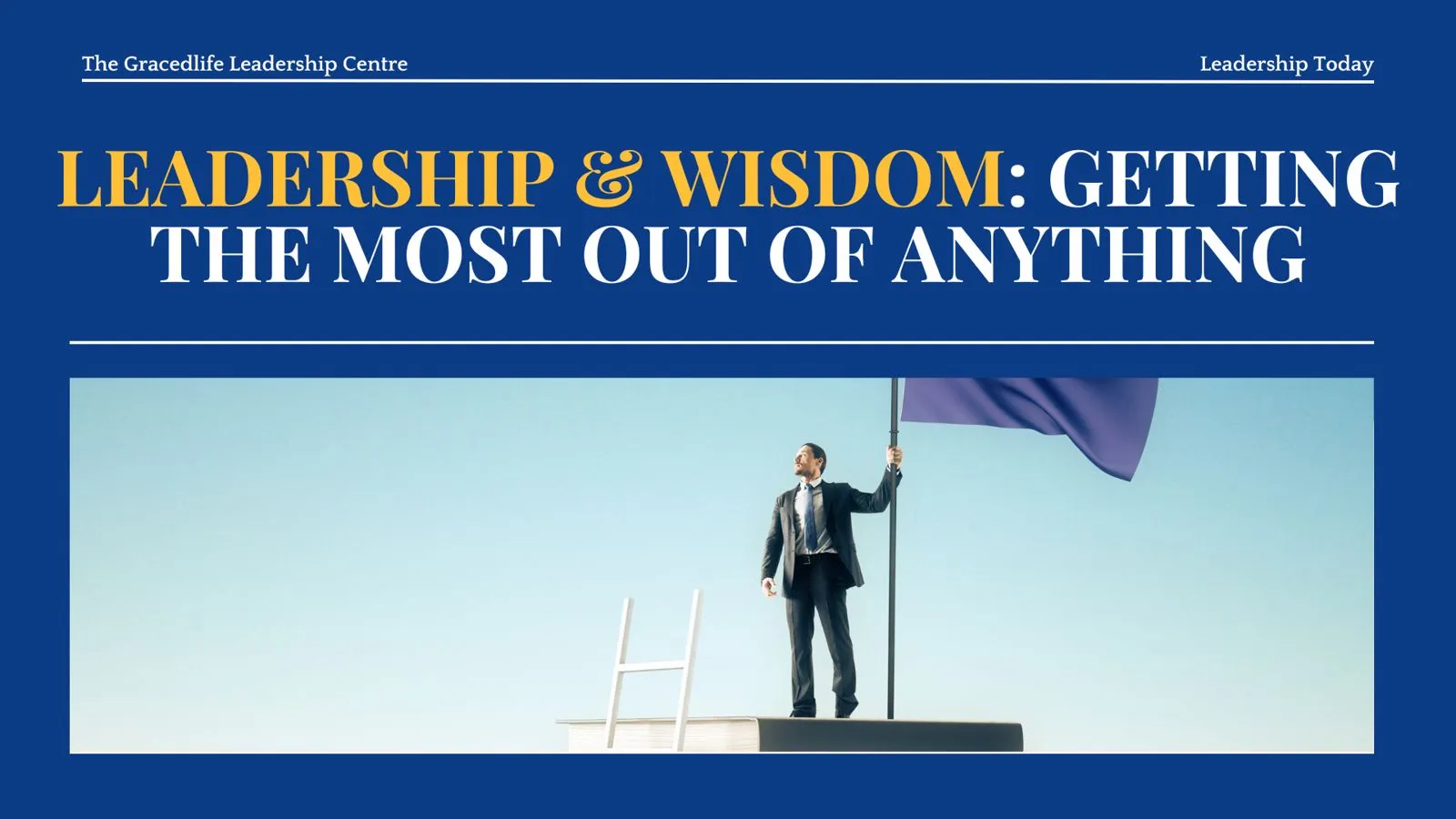
LEADERSHIP TODAY · Episode 7
In the previous episode, we looked at the constrained environment every leader works inside. Limited time. Limited money. Limited people. Limited attention. Leadership, in that environment, is the question of how I make the best possible return. If it is profit, I am maximising profit while minimising cost. If it is impact, I am maximising impact while minimising cost. Maximum learning at minimum waste.
Today, I want to put a name to the thing that actually lets a leader do that. Wisdom.
A lot of us hear that word and our minds go somewhere abstract. A grey-haired elder. A proverb. A line in a sermon. But wisdom, in the way leaders need it, is more practical and measurable than that.
Wisdom is the best possible use of anything of value, whatever that thing is. Wisdom is how I get the maximum return or outcome out of anything, out of any input.
If I have one thousand, what will be the best possible use of one thousand in order to have the maximum outcome? That is wisdom.
Picture two people who have just been given one thousand cedis and told to feed a family for the month. One walks to the market and buys whatever catches the eye on the way home. By the second week, the money is gone and there is nothing in the house. The other sits down with a paper, lists what the family eats, calculates what one thousand cedis can stretch to, buys staples that store well and a small amount of fresh things, and feeds the family for the full month with something left over. Same input. Different outcome. The difference is not magic. The difference is wisdom.
If it is a little space, what will be the best possible use of little space in order to get the best outcome? That is wisdom. If it is knowledge, what is the best possible use of that knowledge? I sat in an economics class and learned about demand and supply. What is the best possible use of that knowledge to achieve the best possible outcome? That is wisdom. I sat in an accounting class. What is the best possible use of debit and credit, the knowledge of debit and credit, to achieve the best possible outcome? Same answer.
Now zoom out. That is exactly what leadership is.
A leader who has one office, three staff, and a tight budget is not in a different game from that mother in the market. They are in the same game. The question is the same: given what I have, what is the best possible use of it?
For a leader, wisdom is not abstract. It is the daily skill of the work, and it is what separates a leader who multiplies what they have from a leader who only consumes it.
Because wisdom seeks to maximise outcome, impact, and benefit with whatever input it has, it does not work alone. Wisdom seeks two things. Knowledge and understanding. Without them, wisdom has nothing to work with.
Understanding is how to see one thousand and see what can come out of it. It is how to see a rock and see a cathedral out of it. It is how to see something that is almost insignificant, a little input or a small resource, and see the most outcome of it. That is understanding. Without understanding, one thousand cedis is just a stack of paper. With understanding, that same one thousand is a month of meals, or the seed of a small business, or the start of someone's school year.
Knowledge is knowing what has been done, what can be done, and what is being done, so that you are able to maximise the output. The mother who feeds the family well does not only have understanding. She knows which foods store. She knows what the children will actually eat. She knows which market sells gari cheaper. The leader who turns a small budget into real impact does not only imagine the possibility. They know how others have done it before. They know what is currently working. They know which methods have failed. Knowledge is the catalogue. Understanding is the eye that reads it.
So we sit in classrooms. We learn supply and demand. We learn debit and credit. And then a quiet question follows us out of the classroom: what is the best possible use of this? That question is the doorway to wisdom. Without it, knowledge sits on a shelf in our heads and gathers dust. With it, knowledge becomes outcome.
The ancient text says it plainly. Wisdom is the principal thing; therefore get wisdom. And in all your getting, get understanding (Proverbs 4:7, NKJV). The verse does not tell us to get more resources, or more time, or to wait for better conditions. It tells us to get wisdom. Because the leader who has wisdom can do more with little than the leader without wisdom can do with much.
Sit with that for a second. The leader who has wisdom can do more with little than the leader without wisdom can do with much. So the question for the week is not, do I have enough? The question for the week is, am I making the best possible use of what I already have?
Look at your week. Look at the people on your team. Look at the cash in your account. Look at the hours between Monday and Friday. Look at the knowledge you carry from every classroom, conversation, and book that has shaped you. None of it is small. The smallness, when it shows up, is rarely in the input. It is almost always in our use of the input.
Ask yourself three questions before the week begins. What do I actually have, named honestly and counted plainly? What is the best possible outcome this could produce, if used wisely? What knowledge or understanding am I missing that would close the gap between what I have and what it could become?
Most of us skip these questions and run straight to I need more. More money, or more staff, or another month on the calendar. Sometimes the answer really is more. But far more often, the answer is wisdom. The answer is understanding. The answer is knowledge. The answer is to look again at what is already in our hand.
A rock can become a cathedral. One thousand cedis, used carefully, can feed a family for a month. A small team has changed towns before. One classroom hour has shaped a leader for forty years. None of that happens by accident. It happens when someone, somewhere, decides to make the best possible use of what is already there.
That is wisdom at work. It is also what leadership, at its truest, looks like.
Until next week, lead today. Lead yourself so you can lead others. We are TGLC.
Watch at: https://youtu.be/FpHV_Khvc3c