Can initiative be taught?
Africa needs young people who start things without waiting to be asked. Rigorous studies suggest a self-starting habit can be trained. Our own monthly records point the same way, with limits we set out plainly.
Ask employers, funders or community leaders what young people need most and many will name the same quality: initiative, the habit of seeing what needs doing and starting it without being told. Businesses, projects and reforms all begin with someone who acts first. If initiative is fixed temperament, programmes can only select for it. If it can be developed, it belongs at the centre of how we train young leaders.
What rigorous studies have found
The strongest evidence comes from West Africa. In a randomised trial with 1,500 small business owners in Lomé, Togo, a psychology-based course that teaches a proactive mindset raised firm profits by 30% over two years, against a statistically insignificant 11% for a leading traditional business training programme (Campos and colleagues, 2017). Seven years later, the same researchers found profits were still $91 a month higher on average for those trained in personal initiative. The long-term gains grew for men and were flat or declining for women, which shows that the effect depends on more than the training itself (Campos and colleagues, 2025).
That result stands out because business training usually struggles to show results. A review of evaluations across developing countries found that few studies detect significant effects on profits or sales, and many are too small or too short to tell (McKenzie and Woodruff, 2014). Leadership training more broadly does better: a meta-analysis of 335 studies found that it improves what people learn and, importantly, what they transfer to their work (Lacerenza and colleagues, 2017).
What our records show
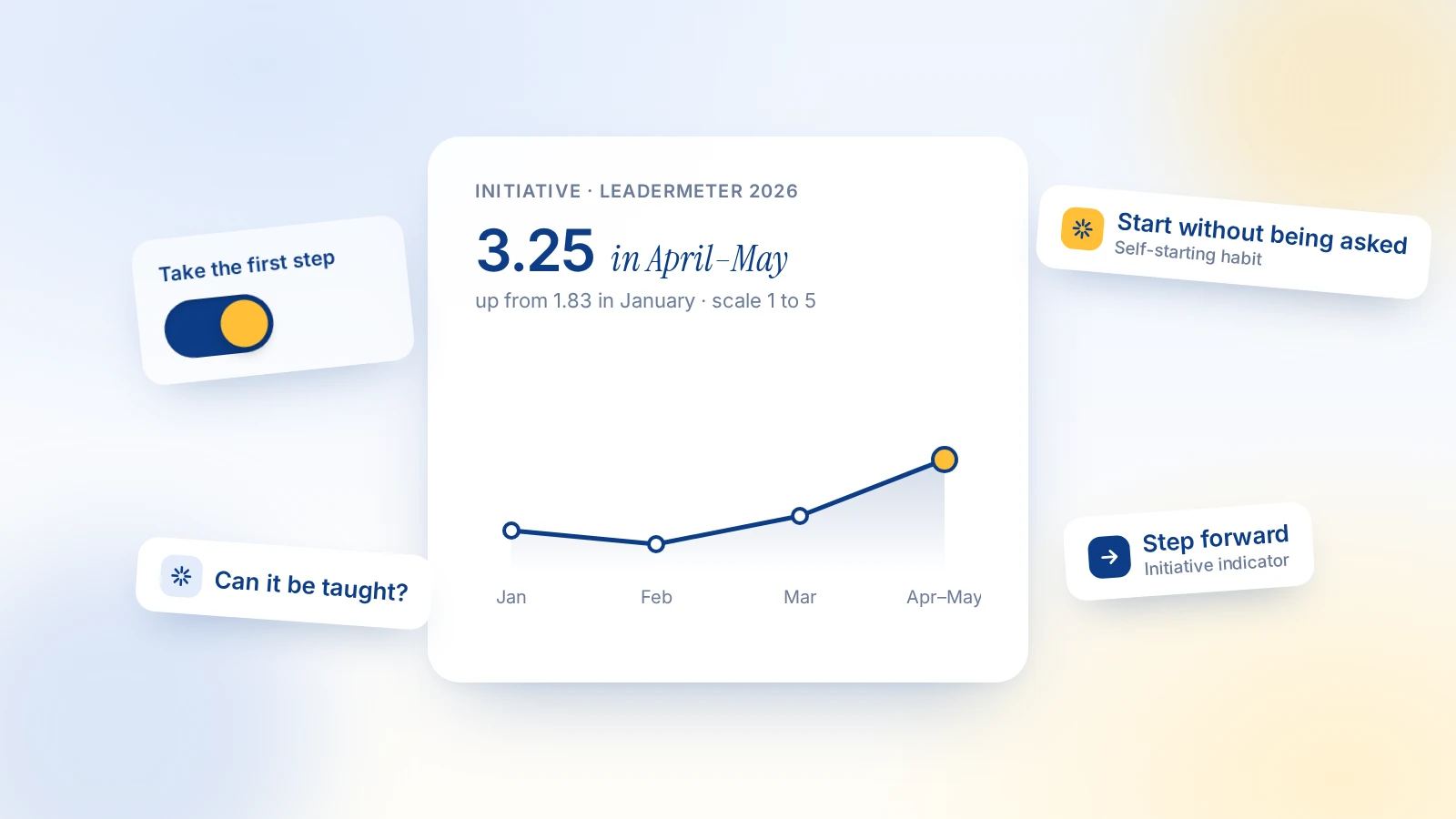
In our Leadership Experience Programme, leaders complete LeaderMeter each month, scoring themselves from 1 to 5 on seven indicators. Initiative asks what they started outside their assigned tasks that month. Across 64 monthly reports from leaders currently active in the programme, initiative is the lowest-scoring indicator, at an average of 2.08. Problem solving is the highest indicator in those 64 reports, at 3.63. The young people we serve tend to work a problem well once it is in front of them and find it harder to start something nobody asked for.
In the current programme year, the average initiative score was 1.83 in January 2026 (12 reports), 1.57 in February (7) and 2.13 in March (8). April and May each had only four reports, so we combine them to avoid reporting on groups smaller than five: across those eight reports the average initiative score was 3.25. Other indicators rose over the same months, and the overall monthly score moved from 2.50 in January to 3.63 across April and May.
Following the same people
Monthly averages can mislead when different people report each month. A better test follows the same leaders over time. Five leaders filed three or more reports between January and May 2026, 23 reports in all over three to four months. For these five, initiative rose from an average of 2.20 in their first report to 3.40 in their latest, a gain of 1.20 points, and it rose for all five. That was the largest change of the seven indicators. Commitment rose by 0.60, adaptability by 0.40, and problem solving and measuring successes and failures by 0.20 each. Learnings did not change, and keeping one’s word fell by 0.40.
The previous programme year tells a different story. Among the ten leaders who filed three or more reports in that year, initiative fell from an average of 2.60 in their first report to 2.00 in their latest. We do not yet know why the two years differ. The programme, the cohort and the number of reports all changed between them.
What this evidence can and cannot show
Our records are consistent with the trials: initiative starts low and can move. They do not prove that our programme caused the change. The scores are self-reported, so a rise may reflect growing confidence or familiarity with the form as much as new behaviour. The group we can follow is five people, and the leaders who keep reporting are likely to be the most engaged. There is no comparison group, the window is five months, and the opposite pattern in the previous year is a reminder of how much these numbers can vary.
To test the question properly we need a behavioural measure of initiative, such as projects started or mentor ratings, a full programme year of reports, and a group of similar young people who did not take part. Our second Tracer Study and the task records we are rebuilding are first steps toward that.
Sources
- Campos, F., Frese, M., Goldstein, M., Iacovone, L., Johnson, H. C., McKenzie, D. and Mensmann, M. (2017). Teaching personal initiative beats traditional training in boosting small business in West Africa. Science 357 (6357), 1287 to 1290. science.org/doi/10.1126/science.aan5329
- Campos, F., Frese, M., Iacovone, L., Johnson, H. C., McKenzie, D. and Mensmann, M. (2025). Long-term and lasting impacts of personal initiative training on entrepreneurial success. American Economic Review: Insights 7 (4), 463 to 479. aeaweb.org/articles?id=10.1257/aeri.20240581
- McKenzie, D. and Woodruff, C. (2014). What are we learning from business training and entrepreneurship evaluations around the developing world? World Bank Research Observer 29 (1), 48 to 82. World Bank working paper 6202 (PDF)
- Lacerenza, C. N., Reyes, D. L., Marlow, S. L., Joseph, D. L. and Salas, E. (2017). Leadership training design, delivery, and implementation: a meta-analysis. Journal of Applied Psychology 102 (12), 1686 to 1718. doi.org/10.1037/apl0000241
- The GracedLife Leadership Centre. LeaderMeter 2.0, Leadership Experience Programme monthly self-assessment, report month May 2026 (internal records; aggregates only).
Press and enquiries
Emmanuel Goodglory
Director, Research, Africa Impact & Global Visibility
The GracedLife Leadership Centre
egoodglory@gracedlifeleaders.org
General enquiries
TGLC Research Desk
research@gracedlifeleaders.org