Young leaders and the Sustainable Development Goals
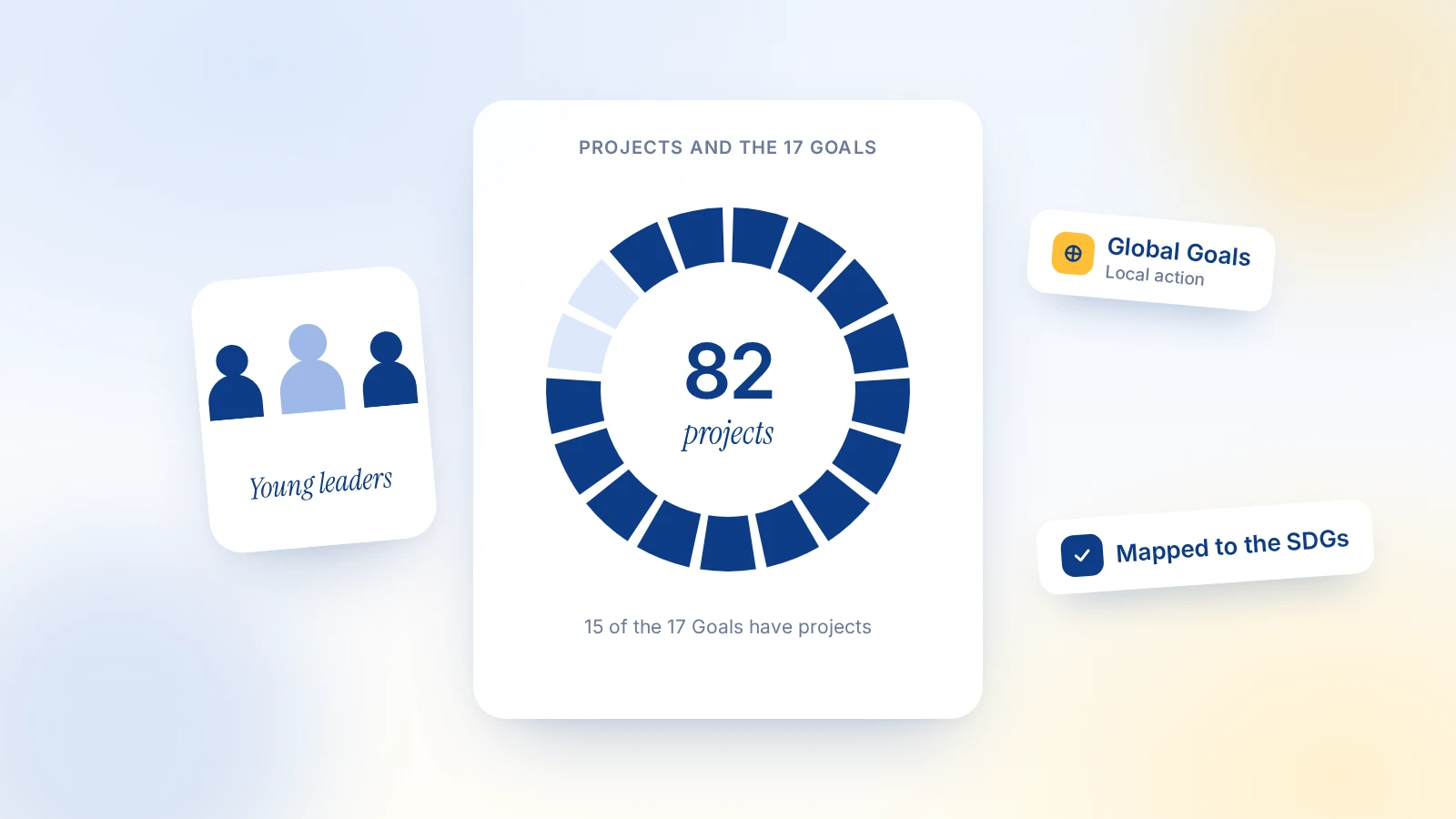
The young leaders in our network are running 82 projects. When we map their work against the 17 Sustainable Development Goals, they cover 15 of the 17 goals, with a clear focus on education and work.
The Sustainable Development Goals are often discussed as a task for governments and large institutions. Yet much of the work happens in small projects started by young people in their own communities. We wanted to know where the young leaders in our network are putting their energy, and which goals they are leaving untouched.
Where our leaders are building
Our database records 82 leadership projects run by the aspiring leaders in our network. Each project lists the goals it serves, and a project can list more than one. We counted how many projects name each of the 17 goals. Together they cover 15 of the 17 goals.
One goal stands out. Quality Education (Goal 4) appears in 32 projects. Decent Work and Economic Growth (Goal 8) follows with 13 and Industry, Innovation and Infrastructure (Goal 9) with 9. Good Health and Well-Being (Goal 3), Gender Equality (Goal 5) and Partnerships for the Goals (Goal 17) each appear in 5. The other nine goals with projects each appear in between one and four.
The same pattern shows in our Impact Labs, the sectors leaders choose to grow in. Education and Social Training is the largest with 35 leaders, followed by Business and Entrepreneurship with 25, Communications and Influence with 15 and Social Group Empowerment with 14.
This makes sense. Young people build where they have lived experience and a clear way in. Teaching, tutoring and mentoring need little capital. Poverty and work are the pressures young Ghanaians feel most directly. Our own programmes, which centre on leadership education and enterprise, also pull leaders in this direction.
The gaps
Only two goals have no projects: Life Below Water (Goal 14) and Life on Land (Goal 15). Zero Hunger (Goal 2) has two projects and Affordable and Clean Energy (Goal 7) has one. These goals often call for technical knowledge, equipment and specialist partners, which may be part of why fewer young leaders start there.
For us, the gaps are an invitation. We would like to work with partners in agriculture, energy and the environment who can help young leaders find a way into these goals.
What this evidence can and cannot show
These counts show intention and alignment. They do not show results. Leaders choose the goals themselves, and the way goals are recorded in our projects list is not yet consistent. We do not yet collect the reach or outcomes of each project, so we cannot say how much any project has moved its goal. Totals across goals add up to more than 82 because seven projects name several goals, and four projects do not yet name a goal. The counts include both active and inactive projects.
A note on method. Our database dashboard also has an SDG table (rows 57 to 73) that gives lower figures. That table counts leaders from a different sheet and shows zero for Goals 2, 3 and 7, even though the Projects sheet lists projects for all three. We use the Projects sheet as the primary source for this piece.
Our second Tracer Study asks graduates which goals their work serves and how many people it reaches. That will let us move from where leaders say they are working to what their work achieves.
Press and enquiries
Emmanuel Goodglory
Director, Research, Africa Impact & Global Visibility
The GracedLife Leadership Centre
egoodglory@gracedlifeleaders.org
General enquiries
TGLC Research Desk
research@gracedlifeleaders.org